Self-Healing Test Automation: Fixing Broken Locators Before They Break Your Build
A developer renames a button and half your regression suite turns red. What self-healing tools actually fix, how mabl, Functionize, testRigor and Testim differ, and what to ask before you choose one.

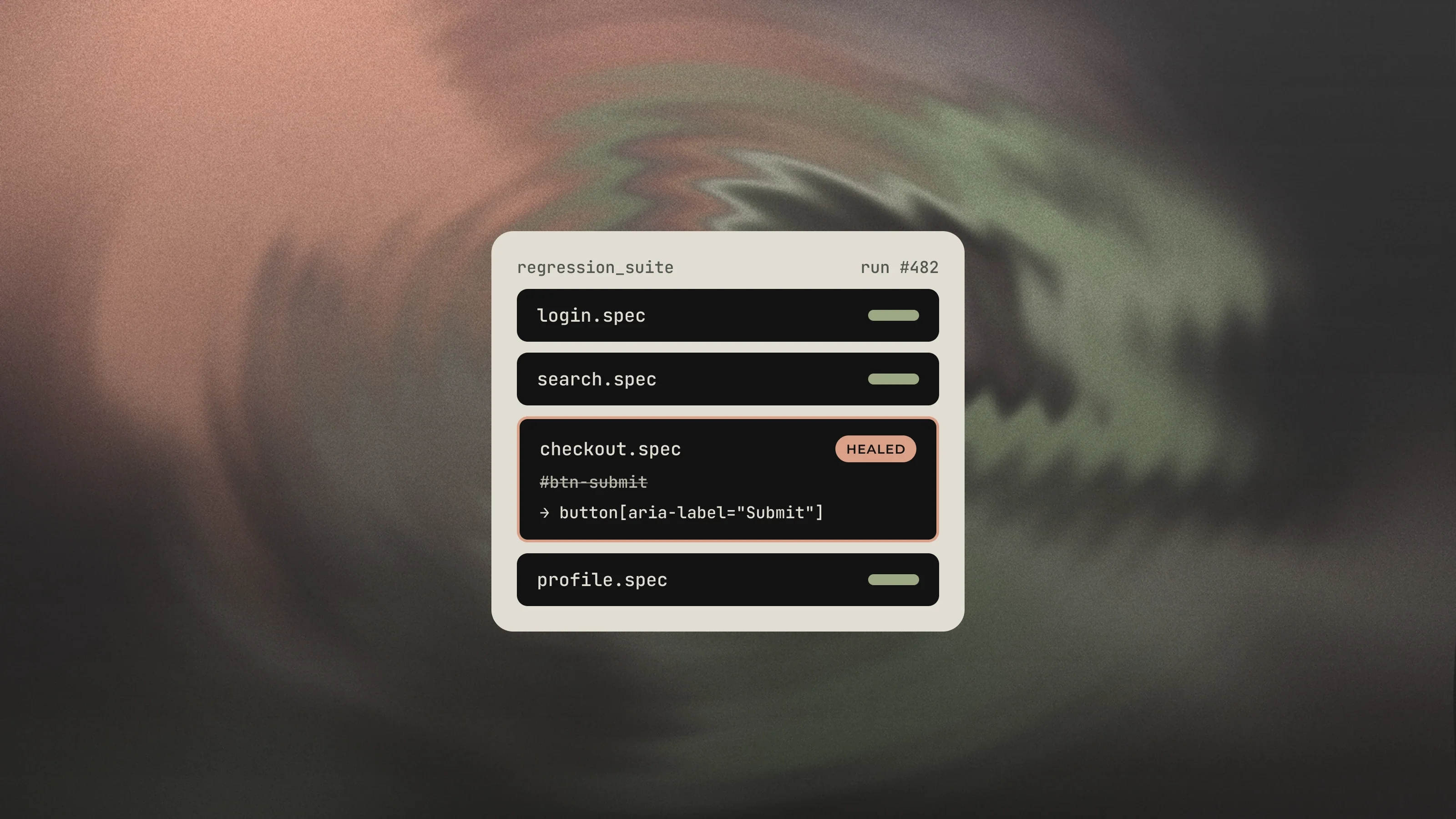
If you’ve spent any time in test automation, you already know the drill: a developer renames a button, a CSS class gets updated, or an element shifts during a redesign. Suddenly, half your regression suite is red, and you’re spending hours updating locators instead of actually testing the product. Beyond just frustrating the QA team, this creates real friction between developers and testers. Developers are focused on pushing updates and moving fast, while testers struggle to keep the test suite stable and predictable. It’s a recipe for team tension.
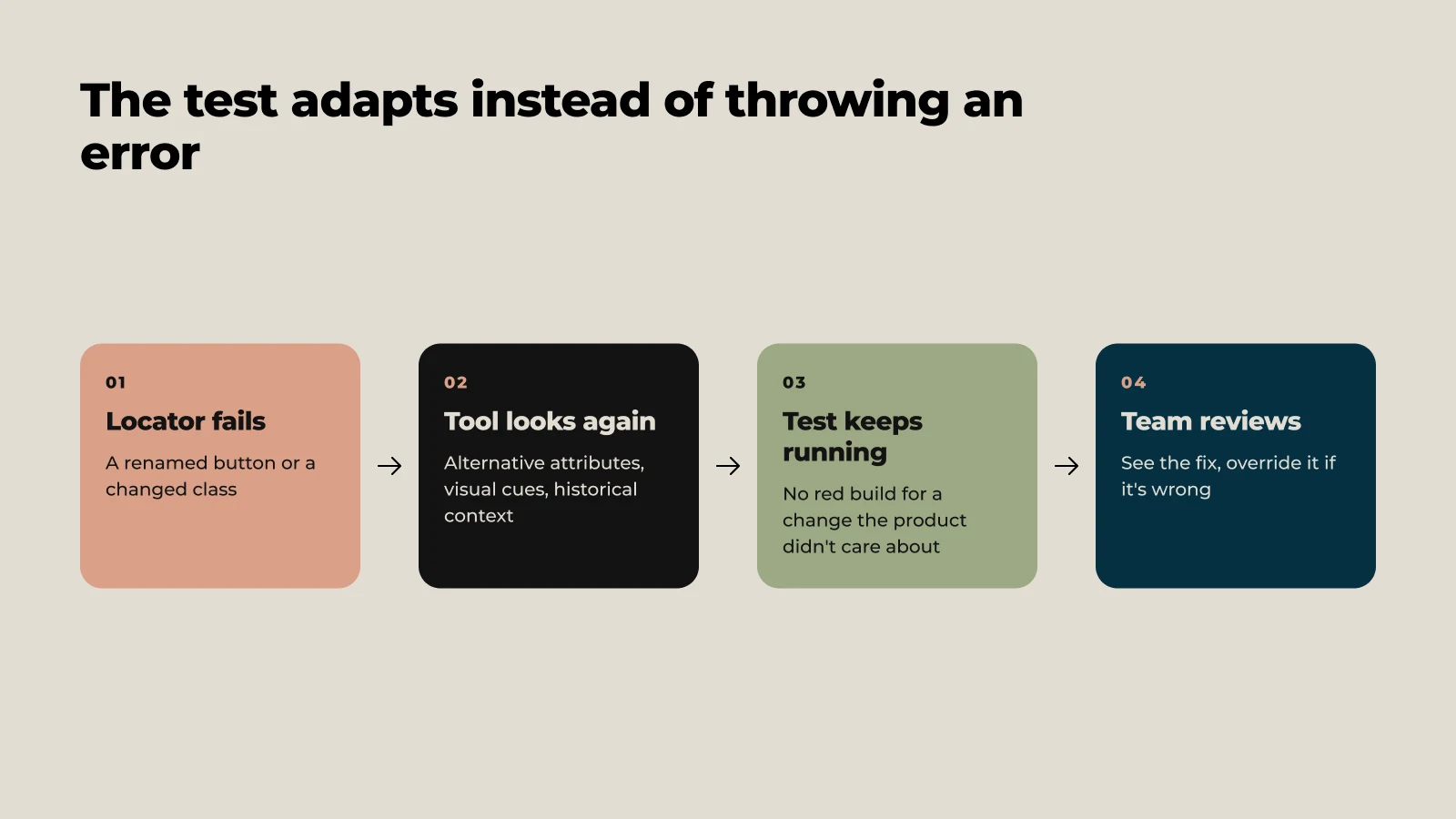
Self-healing test automation tools are designed to step in right here. Instead of throwing an error the second a locator fails, these tools automatically adapt. They find alternative attributes, rely on visual cues, or use historical context to keep the test running, saving teams from the nightmare of constant maintenance.
Why it actually matters
Broken tests create noise and destroy trust. When test maintenance becomes too expensive or time-consuming, teams start ignoring failures, delaying fixes, or bypassing the automation suite altogether. Self-healing brings that trust back. For fast-moving teams deploying frequently, it ensures the automation layer works with the release cadence, not against it.
The tool landscape
There is a lot of buzz around self-healing, but the most popular platforms approach the problem in slightly different ways:
- mabl: A great fit for teams wanting low-code automation. It relies on machine learning-driven locator fallback and plays very nicely with CI/CD workflows.
- Functionize: Leans heavily into visual intelligence and AI to catch UI drift and adapt to visual changes rather than just DOM elements.
- testRigor: Takes an intent-based approach. You write tests in plain English, and the platform figures out how to execute the steps, shifting the focus entirely away from fragile CSS or XPath locators.
- Testim: Uses an ML-weighted locator system. It learns which locators are the most stable over time and adapts intelligently when changes happen.
Not all "healing" is created equal
Don’t let the blanket term "self-healing" fool you: these tools operate very differently under the hood.
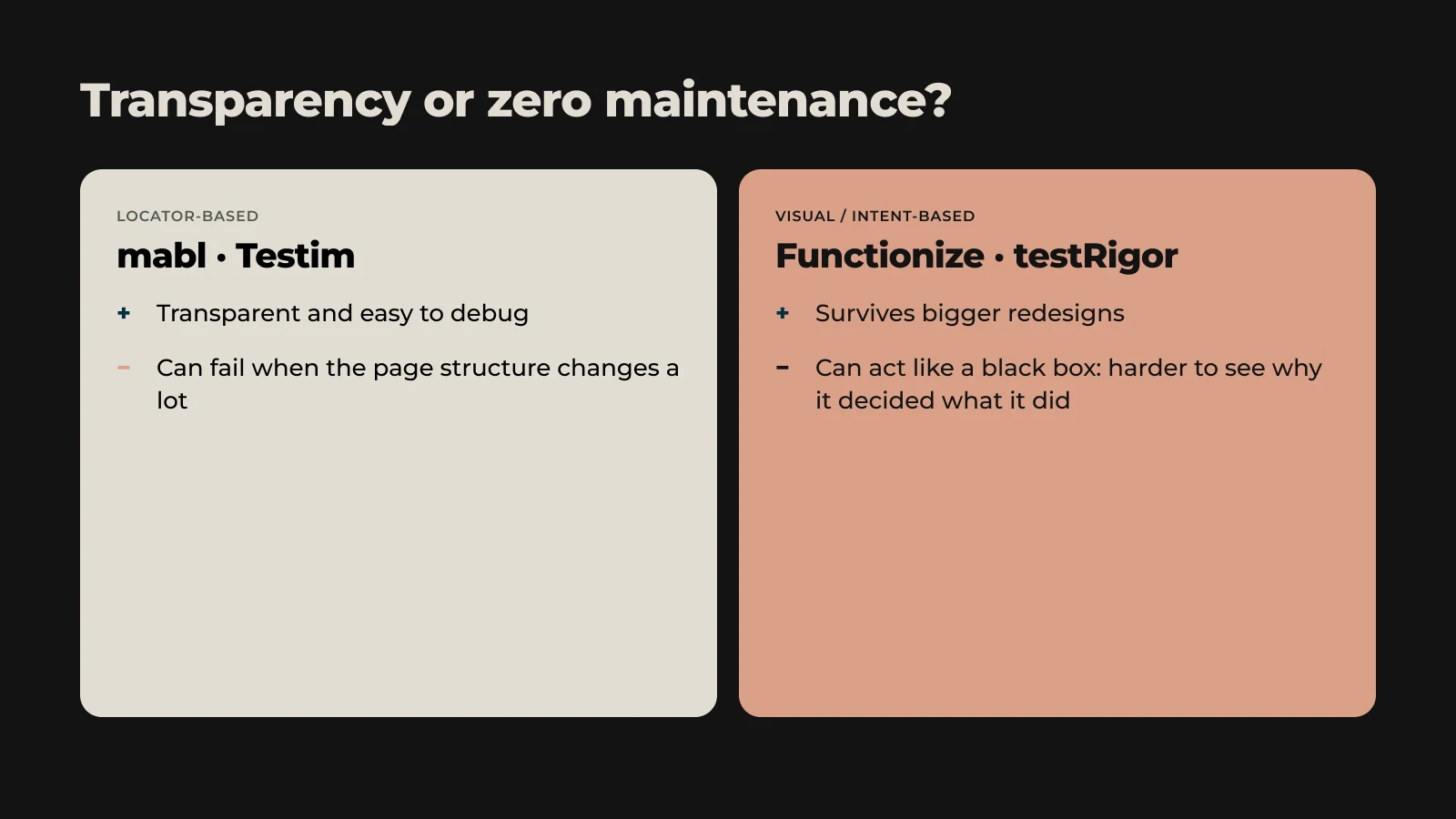
Basic locator fallback is usually highly transparent and easy to debug, but it might still fail if a page undergoes a massive structural change. On the other hand, intent-based or visually driven tools can survive bigger redesigns, but they sometimes act as a "black box", making it harder to understand why the tool made a specific decision. You have to decide what your team values more: total transparency or zero-maintenance execution.
The reality check: it’s not magic
As great as self-healing is, it won’t fix bad framework architecture. If an application is completely overhauled, human review is still going to be necessary.
There are also trade-offs to consider. Leaning entirely on a smart tool often means heavy vendor lock-in, making it difficult to port your tests elsewhere. Self-healing should act as a safety net, not a replacement for good test design, stable locators, and proper page structure.
How to choose the right tool
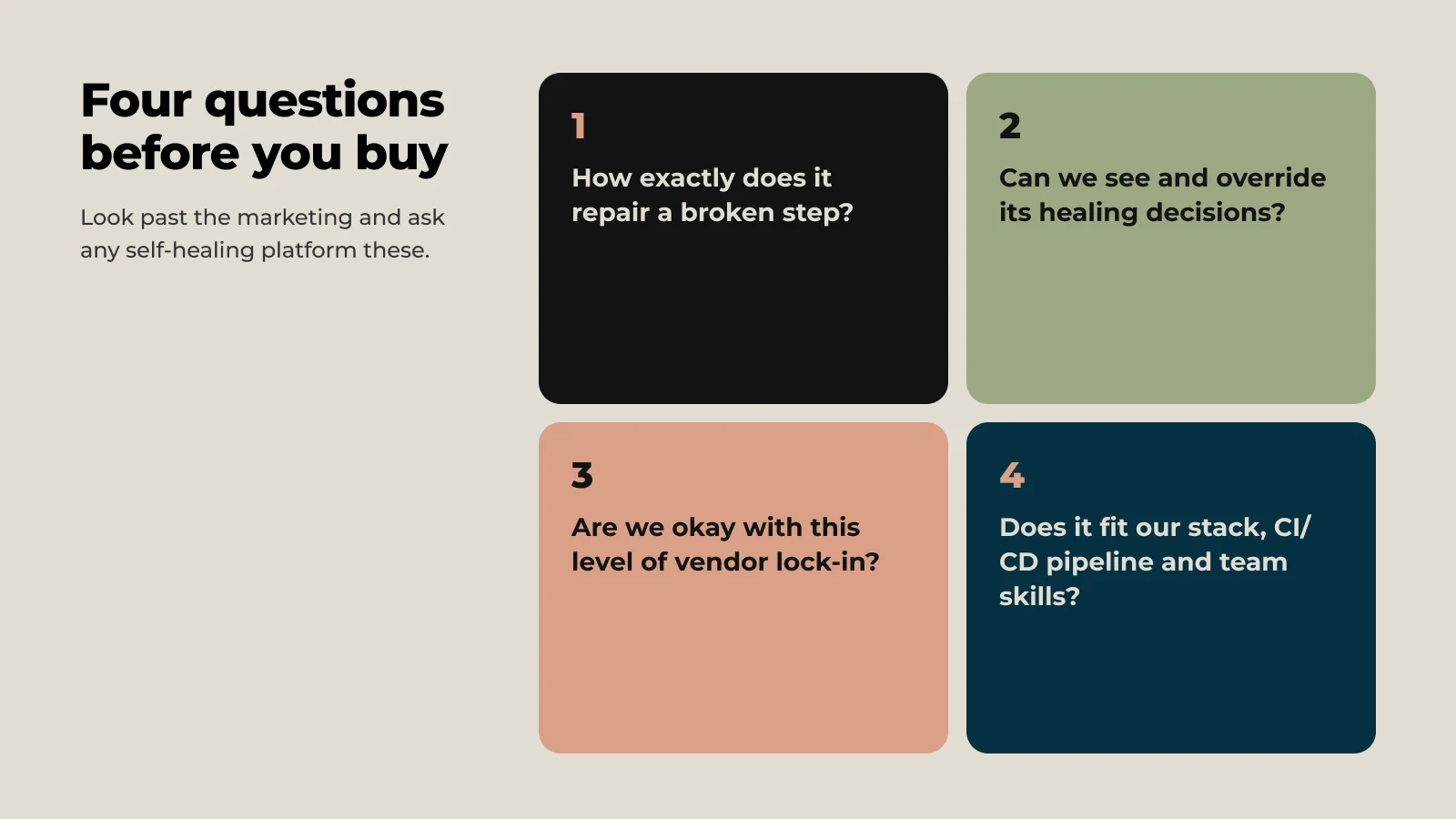
If you’re evaluating a self-healing platform, look past the marketing hype and ask these practical questions:
- How exactly does the tool repair a broken step?
- Can I easily see and override the tool’s healing decisions?
- Am I okay with the level of vendor lock-in?
- Does this fit naturally into our current tech stack, CI/CD pipeline, and team skill set?
At the end of the day, brittle tests that fail for no good reason are one of the biggest bottlenecks in modern QA. Tools like mabl, testRigor, and Testim prove that automation can be resilient, as long as you use that AI to support solid engineering practices rather than treating it as a substitute for them.
How we implement self-healing at House of Test
At House of Test, we approach self-healing automation strategically to bridge the gap between development and QA. Instead of a one-size-fits-all approach, we analyze your architecture and identify the root causes of flaky tests to select the right tool for your ecosystem.
We start with a targeted Proof of Concept (PoC) on your most brittle workflows to quickly prove ROI. Next, we integrate the solution transparently into your CI/CD pipelines to prevent "black box" risks. Finally, we upskill your team, eliminating constant test maintenance so your engineers can focus on delivering software faster.
Do you want to learn more? Read about our test automation services, or get in touch.

I've spent 14 years in IT, working mainly as a software tester, with experience as a Scrum Master and developer. I also run workshops on software testing and bread baking. I enjoy solving problems and sharing what I know. Outside work, I love cooking, hiking, and running, always looking for my next challenge.